

- This event has passed.
Reed It and Weep: Invasive Phragmites Australis in a Great Lakes Coastal Marsh
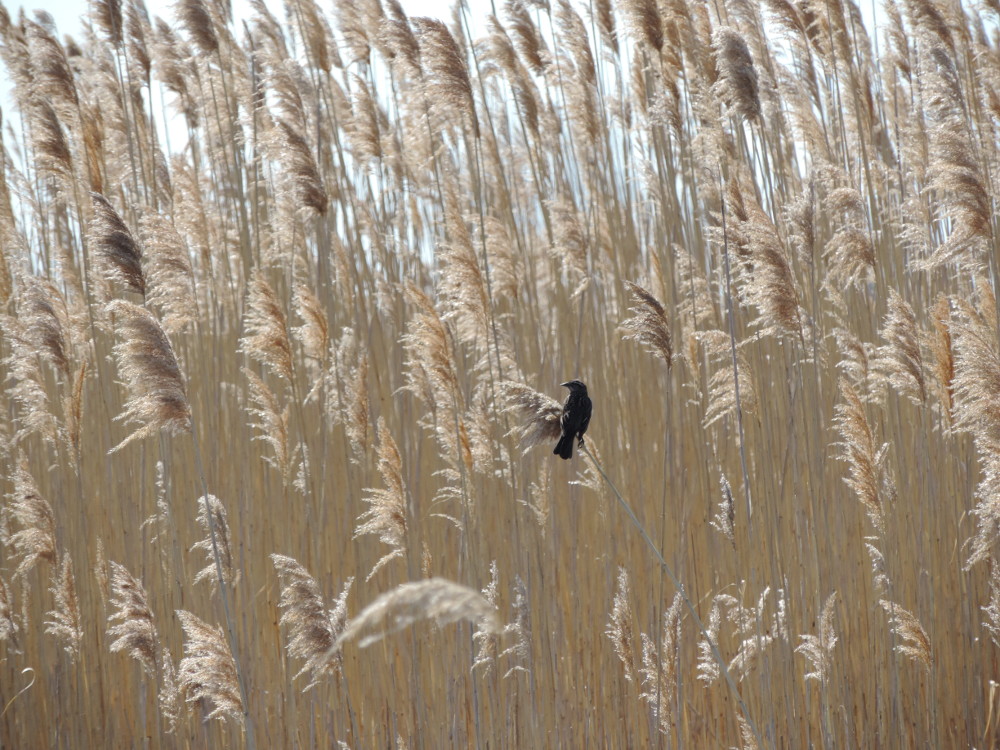

European Common Reed, known to scientists as exotic Phragmites australis, is an invasive wetland grass currently spreading throughout North America. Common Reed is capable of replacing diverse wetland plant communities with expansive monocultures in just a few years, creating dense stands that can reach over 6 meters in height. Common Reed has been expanding at the internationally important coastal marshes of Long Point, ON since the late 1990s. These marshes are a designated UNESCO World Biosphere Reserve and are home to unique plant communities, such as coastal marsh meadow. They provide critical habitat for marsh nesting birds, which are in decline around the Laurentian Great Lakes. Common Reed has been replacing important emergent marsh and marsh meadow habitat in Long Point, prompting our work to quantify the effects of the invasion and the outcomes of Common Reed control efforts.
The emergent marsh and marsh meadow habitat that Common Reed is replacing is essential habitat for marsh nesting species of birds, including species at risk such as Least Bittern. One goal of our work is to characterize the effects that this habitat conversion has on the abundance, species richness and community composition of the birds using Long Point marshes, because of the importance of this region to bird migration and breeding. In addition, we are contrasting the plant communities and rates of primary production and decomposition in invaded, uninvaded and treated marsh habitat to gain insight into the risks posed by the invasion and how best Common Reed can be eliminated and native vegetation restored. We can apply this knowledge to improve land management and invasion control. In large infestations like the one at Long Point, the recommended treatment methods include herbicide application and removal through rolling or burning. This component of our work examines how these treatments affect the regrowth of desirable resident species, and aims to follow the long term responses of wetland plants to these control methods.

Presenters: We’re fortunate to have three presenters, all graduate students of Dr. Rebecca C. Rooney, Dept. of Biology, University of Waterloo.
Sarah Yuckin: I completed my undergraduate degree in Environmental Sciences at the University of Alberta in 2011. Since graduation I’ve worked on a variety of wetland oriented projects, and currently I’m working on my master’s thesis focused on Phragmites australis in Long Point on Lake Erie.
Graham Howell: I completed my undergraduate degree in Environment and Resource Studies at UW, earning a diploma in Ecological Restoration and Rehabilitation. With my graduate degree I will be exploring the impact of the invasive reed Phragmites australis within the Long Point region, with a focus on restoration projects studying control techniques.
Courtney Robichaud: I received my undergraduate degree from UW in 2013. Shortly after I joined the Rooney lab as a research technician, with a focus on examining the effects of invasive Phragmites australis on bird communities in Long Point, ON. In 2015 I continued this work as a master’s student, further examining changes in bird traits and the role competition plays in Phragmites invasion.

photos supplied by the presenters